Ice Dams on Rhode Island Roofs, Explained
How ice dams actually form on a Rhode Island roof, and what genuinely helps keep water out from under the shingles.
September 22, 2026 · 3 min read
Ice dams are one of the most common calls a Rhode Island roofer gets between January and March, and they are also one of the most misunderstood. Most homeowners assume the snow itself is the problem. Usually it isn't. The problem is what happens to that snow once it starts to melt and refreeze on its way down the roof, over and over, in a slow cycle that can run for weeks during a hard winter.
How an ice dam actually forms
Heat escaping from the living space into the attic warms the underside of the roof deck. That heat melts the bottom layer of snow on the upper, warmer part of the roof, and the meltwater runs down underneath the snow blanket above it. When that water reaches the colder overhang past the exterior wall, it refreezes and starts building a ridge of ice right at the eave. More meltwater keeps arriving behind that ridge, and with nowhere left to run off, it backs up and works its way up and under the shingles instead, right into the house. This whole cycle can repeat for weeks straight through a cold Rhode Island winter, with the ice ridge growing a little more after every thaw.
Why some roofs get them worse than others
Attic insulation and ventilation matter more here than the shingles themselves. Recessed lighting, bathroom fans that vent warm moist air straight into the attic instead of outside, and complex roof shapes with valleys where snow piles up deep all speed up the melt and freeze cycle right above the eaves. Two houses next door to each other can have very different ice dam problems depending entirely on what's happening in the attic, not what's happening on the roof's surface.
Why gutters get blamed unfairly
Ice dams often get pinned on clogged or poorly hung gutters, and it's an easy thing to blame because the ice sits right where the gutter is. In most cases the gutter is just where the problem becomes visible, not where it started. A perfectly clean, well hung gutter will still grow an ice dam if warm air is escaping into the attic above it. Clearing gutters in the fall is still worth doing, it just isn't the fix for a dam that's already forming, the attic is.
What actually stops water at the eaves
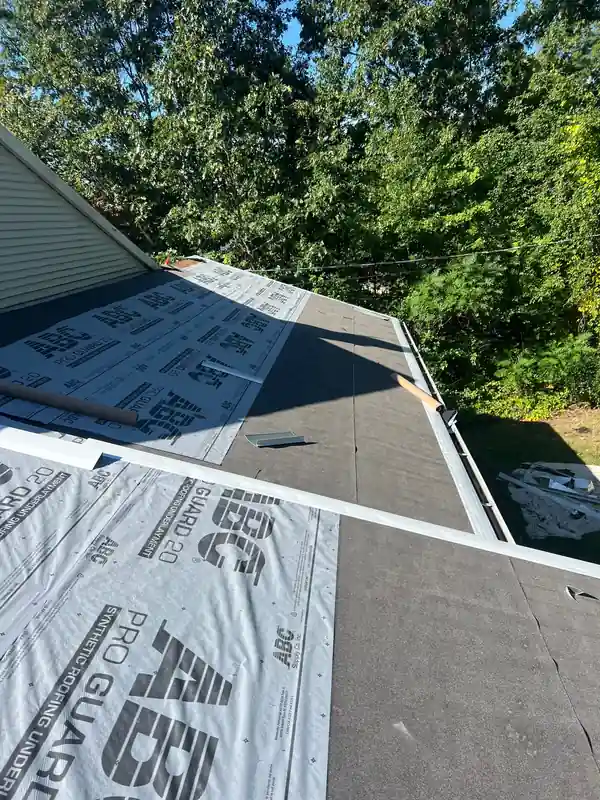
Ice and water shield is a self sealing membrane installed directly on the roof deck, under the shingles, at the eaves and valleys, before the visible roof ever goes on. It gives water somewhere to go besides your ceiling if a dam does form. On a recent North Smithfield reroof, the crew ran a full six feet of ice and water shield up from the eaves specifically for this reason, on top of correctly woven valleys and new decking underneath. That's not a special upgrade, it's simply how a roof should be built in a place that gets winters like ours.
- Better attic insulation, so less heat reaches the underside of the roof deck
- Enough soffit and ridge ventilation to keep the roof close to outdoor temperature
- Sealing the gaps where warm household air sneaks up into the attic
- Ice and water shield at the eaves and valleys whenever a roof gets redone
What to do if you already have one
Stay off the roof yourself, and never chip at an ice dam with an axe or a hammer. It feels productive, but it tends to crack shingles and cause more damage than the ice itself. A roof rake used carefully from the ground can pull fresh snow off lower, reachable sections before it has a chance to feed a growing dam. If water is already coming through a ceiling or down a wall, that's a call to make right away, not something to watch and wait on. A fan pointed at the ice from inside the attic, or a bag of ice melt tossed up onto the roof, are common do it yourself fixes that tend to do more harm than good, they either don't reach the real problem or introduce chemicals that aren't meant to sit against shingles.
If you're seeing ice building up at your eaves this winter, or you already have water finding its way in, call or text Tim at 401-233-ROOF. He's reachable 24 hours a day, and every roof his crew builds goes on with ice and water shield at the eaves and valleys from the start, not as an add on, but as part of building it right for a Rhode Island winter in the first place.
Tim's Roofing and Siding, 401-233-ROOF
Call 401-233-ROOFMore articles
How Long Does a Roof Last in Rhode Island?
What actually wears a Northern Rhode Island roof out, and the signs worth paying attention to before a small problem gets expensive.
Roof Repair or Replace? How to Actually Tell
A plain look at how to tell whether a problem calls for a repair, or it is honestly time to replace the whole roof.